 Skip to content











Hannah was speaking in her heart; only her lips moved, and her voice was not heard...
- 1 Samuel 1:13
God is neither impressed nor moved by our vocabulary or oratory skills.
But, as always, God is concerned with the heart.
God would say to Hannah's son, Samuel, “...the Lord sees not as man sees: man looks on the outward appearance, but the Lord looks on the heart.” God speaks the language of the heart.
Have you ever spoke to God without speaking? Where only the groaning of your inner person can be heard? Extraordinarily, we serve a God whose understanding of his creatures extends even to wordless prayers (Rom. 8:23, 26-27).
That God comprehends our wordless prayers is both hopeful and comforting. We serve a God who not only searches and knows our heart, but He hears us when we are too overwhelmed for language. God speaks the language of our hearts.
There are times when I'm in too much pain and anguish to speak words.
There are times that fear and anxiety are so suffocating that I can't breathe, much more speak.
There are times when I am so exposed that I am ashamed to call upon the name of the Lord, nor could I present Him a verbal prayer.
Praise be to God that in these moments of pain, and weakness, and fear, we serve a God who hears us when we're too overwhelmed for language.
God heard the inner groaning of Hannah. So likewise, God hears and understands our inner thoughts, groanings, and prayers. In Christ, by the groanings of the Holy Spirit, all of our prayers are honored. Even the ones we don't understand ourselves.
Even in the silence, God hears you. Your prayer today, “...”
Press on,
Pastor Harp
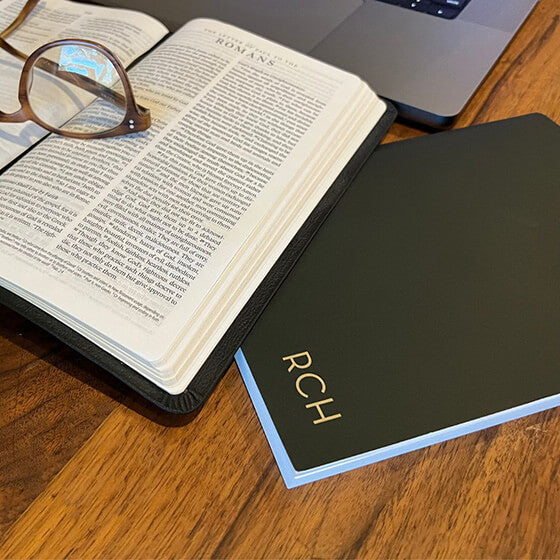
As you reflect on 1 Samuel 1:13, use your Personalized Scripture Journal as a safe place to pour out your heart honestly before God.
Hannah prayed silently, deeply, and emotionally. She did not filter her pain. She brought it directly to Him.
Write through these prompts:
What burden have I been holding inside?
Is there something I have been afraid to say to God?
Where do I need to be more honest in prayer?
What longing or disappointment needs to be released?
How would my relationship with God grow if I trusted Him with my deepest emotions?
After reflecting, write a direct and personal prayer.
Do not polish it.
Do not edit it.
Simply tell Him what you are feeling.
Your journal becomes more than notes — it becomes a place of vulnerability and trust. When you consistently bring your real emotions to God, intimacy deepens.
Over time, you will see that honest prayer strengthens relationship far more than perfect words.
Frequently Asked Questions
What does 1 Samuel 1:13 mean?
It describes Hannah praying silently and deeply, expressing her pain directly to God.
Is it okay to pray emotionally?
Yes. God invites honesty. Authentic prayer builds closeness.
What if I feel misunderstood by others?
Like Hannah, you can bring your heart to God even when others do not understand.
How can journaling help me pray more honestly?
Writing removes pressure to “sound spiritual” and allows true emotion to surface.
Does God really care about my private struggles?
Yes. Scripture shows He sees and responds to sincere, heartfelt prayer.
How does this verse build a personal relationship with God?
It reminds us that intimacy grows when we trust Him with our deepest thoughts and emotions.


2 comments
Denny
Excellent
Excellent
Denny
Excellent
Excellent